February 7, 2022
Samsung’s All-in-One Fingerprint Security IC Enables Safe, Secure and Truly Touchless Transactions

The last time you purchased something at a store, chances are you used a credit or ATM card. Depending on the machine at the register, you may have swiped it, inserted it or tapped it. As payment options have proliferated in recent years, you now have a lot of options – and the newest of these is the biometric payment card.
During the Covid-19 pandemic, contactless payments became mainstream, helping shoppers complete purchases without having to touch potentially contaminated card readers. Mastercard reported that contactless payment transactions were up 40% during the first quarter of 2020, and by 2021, 51% of Americans were using some form of contactless payment method.
Contactless payment cards enable shoppers to complete in-person transactions using RFID technology. Simply hover the card over the card reader, and voila! A secure, contactless payment is completed. Since contactless cards don’t reveal your name, card number, or 3-digit security code, they provide a convenient and secure way to purchase goods.
Taking contactless payment a step further, biometric cards offer another level of security, using fingerprint technology to complete payments. Numerous pilots and commercial rollouts of biometric payment cards are underway, thanks to standards bodies supporting those efforts. For example, EMVCo, a consortium of credit card issuers that develops specifications for issuers and payment networks, recently released functional and security specifications for biometric cards. Fingerprint Cards (FPC) reported that 62% of consumers in the UK say they would switch banks to be able to use a biometric card and 42% would pay more than $10 more for one. With the availability of specifications and standards, and rising demand among consumers across the globe, the Smart Payment Association (SPA) expects biometric fingerprint cards to go mainstream in 2022.
No Pin Code, No Worries
In any credit card transaction, security is a high priority. Credit card fraud has increased sharply during the Covid-19 pandemic, making transactions requiring two-factor authentication – such as swiping or inserting a card and typing in a pin code – less desirable. Biometric cards eliminate that problem and strengthen security by storing all the necessary information to authenticate a transaction on the card itself.
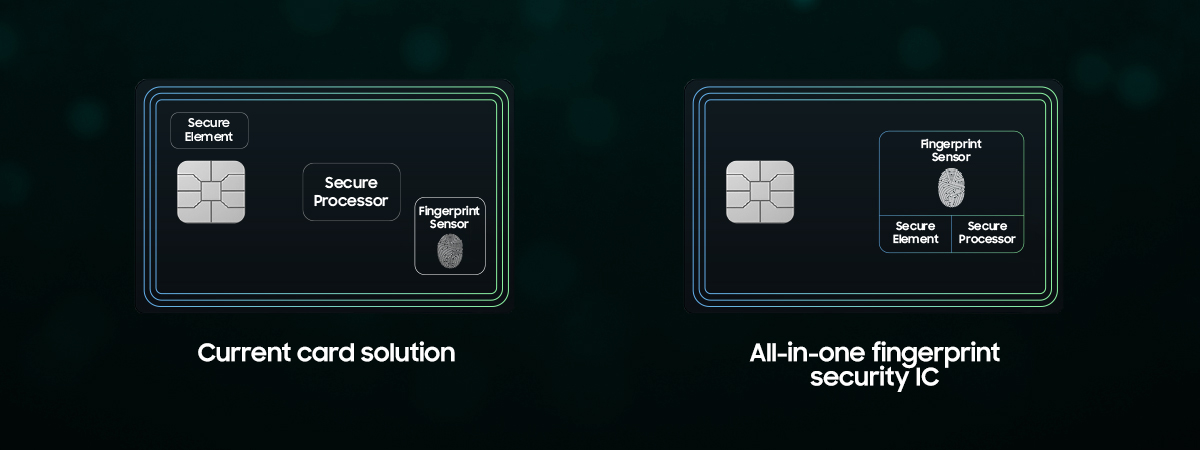
Samsung’s new fingerprint security integrated circuit (IC) ─ the S3B512C ─ combines a fingerprint sensor, a Secure Element (SE) and a Secure Processor (SP) on a single chip, along with enhanced security features made possible by Samsung’s proprietary fingerprint authentication algorithm and anti-spoofing technology. It’s the industry’s first all-in-one security chip that reads biometric information through a fingerprint sensor, stores and authenticates encrypted data in a tamper-proof way, and analyzes and processes data securely, all on one chip.
How Does It Work?
To use the card, an account holder simply enrolls their fingerprint with the card issuer, and the fingerprint data is stored securely within the chip on the card. During a translation, an embedded sensor captures and matches the fingerprint to the digital template stored on the card’s chip, completing the transaction in seconds – no pin code needed.
Samsung’s proprietary fingerprint authentication algorithm works in concert with the SE and SP to extract and analyze unique fingerprint characteristics when the shopper places their finger on the sensor, quickly and accurately verifying the card holder’s identity. At no point does the card holder’s biometric data leave the card, and anti-spoofing technology within the chip prevents scammers and fraudsters from bypassing the security system using artificial fingerprints.
Cards with Samsung’s all-in-one fingerprint security IC delivers numerous benefits:
- Lower manufacturing costs and complexity: Three key functionalities are integrated onto a single chip, eliminating the need to embed multiple chips on a card.
- Improved security: Since authentication relies solely on the encrypted fingerprint information on the card, fraudulent transactions made with lost or stolen cards are impossible.
- Exceptional customer experience: Cardholders enjoy faster, safer, more convenient transactions, with less risk.
While Samsung’s S3B512C was designed for use in payment cards, it can also be used for other cards that require secure authentication, for instance, student and employee IDs, membership cards, or building access cards. It’s EMVCo and CC EAL 6+ certified, as well, and performs in line with Mastercard’s latest Biometric Evaluation Plan Summary (BEPS) specifications for biometric payment cards.
The Future’s In Your Wallet
The biometric technology which was once the stuff of Sci-Fi movies like Star Trek, Bladerunner and Back to the Future is now in our pockets. Thanks to groundbreaking innovations from global leaders like Samsung, ICs such as the S3B512C are paving the way for faster, more convenient consumer experiences – and a future that’s safer and secure. Learn more about how Samsung is securing bank cards for the future of mobile payments.